Zerodha built India's most profitable start-up without investors. Then the regulator changed the market
India's largest discount broker grew on flat fees, no venture capital and almost no advertising. The 2024 tightening of derivatives trading rules cut its revenue and profit in FY25, and shows how much a business model can depend on one product line.
Key takeaways
- Zerodha was founded in 2010 by Nithin and Nikhil Kamath and has grown without outside investors, charging no brokerage on equity delivery and a flat fee on other trades.
- In FY25 its revenue from operations fell to about ₹8,847 crore and net profit to about ₹4,237 crore, a drop of roughly 23%, according to reports based on its filings.
- SEBI's October 2024 measures on index derivatives, including larger contract sizes and one weekly expiry per exchange, hit the trading activity that brokers depend on.
- A cash pile of about ₹22,679 crore gives the company time to change course, but the episode shows the risk of a profit pool shaped by one segment and one regulator.
For most of the last decade, Zerodha was the counter-example Indian founders reached for when someone told them they needed venture capital. The Bengaluru broker was started in 2010 by Nithin Kamath, a former trader, with his brother Nikhil. It never raised outside money. It spent little on advertising. And it became one of the most profitable private companies in the country.
Then, in October 2024, the Securities and Exchange Board of India changed the rules for the product that had driven much of the industry's growth: index options. Zerodha's next set of accounts showed what that meant for a business that had been built, in part, on that activity.
The flat-fee bet
When Zerodha started, Indian brokers mostly charged a percentage of the value of each trade. Zerodha flipped that. Its published charges today show no brokerage on equity delivery trades, and a flat fee, capped at ₹20 per executed order, on intraday and derivatives trades.
The pricing did two things. For long-term investors, it removed a cost that had made small, regular purchases unattractive. For active traders, it made the cost of each trade predictable and low, which encouraged more trading. Both groups found their way to Zerodha, and the company's online platform, Kite, became one of the most widely used trading apps in the country.
Because it did not take investors, Zerodha also did not face the usual pressure to spend heavily on customer acquisition. The company has said in its own updates that it relied on word of mouth and education, including its free learning platform, Varsity, rather than paid marketing. That kept costs low and margins high.
The profit pool underneath
A flat fee per order rewards volume. The more orders customers place, the more the broker earns, and few products generate orders faster than short-dated index options. Between 2020 and 2024, retail trading in these contracts grew sharply across Indian brokers, and SEBI repeatedly published data showing that most individual traders in the segment lost money.
That combination was uncomfortable for the regulator. On 1 October 2024 SEBI announced six measures to curb speculation in index derivatives. They included raising the minimum contract size from the earlier range of ₹5 lakh to ₹10 lakh up to ₹15 lakh, collecting option premiums upfront from buyers, and allowing each exchange only one benchmark index with a weekly expiry. The National Stock Exchange kept Nifty and BSE kept Sensex. The index changes took effect from late November 2024.
Each measure made frequent, small option trades harder or more expensive. For brokers paid per order, fewer orders meant less revenue.
What the FY25 accounts show
Zerodha's results for the year ended March 2025 were reported by several outlets from its regulatory filings. Entrackr's review put consolidated revenue from operations at about ₹8,847 crore, down from about ₹9,993 crore a year earlier. Indian Startup News, citing Tracxn data, reported net profit of about ₹4,237 crore, down roughly 23% from about ₹5,496 crore. Reported figures vary slightly between sources depending on whether they use consolidated or standalone numbers, but the direction is the same in all of them.
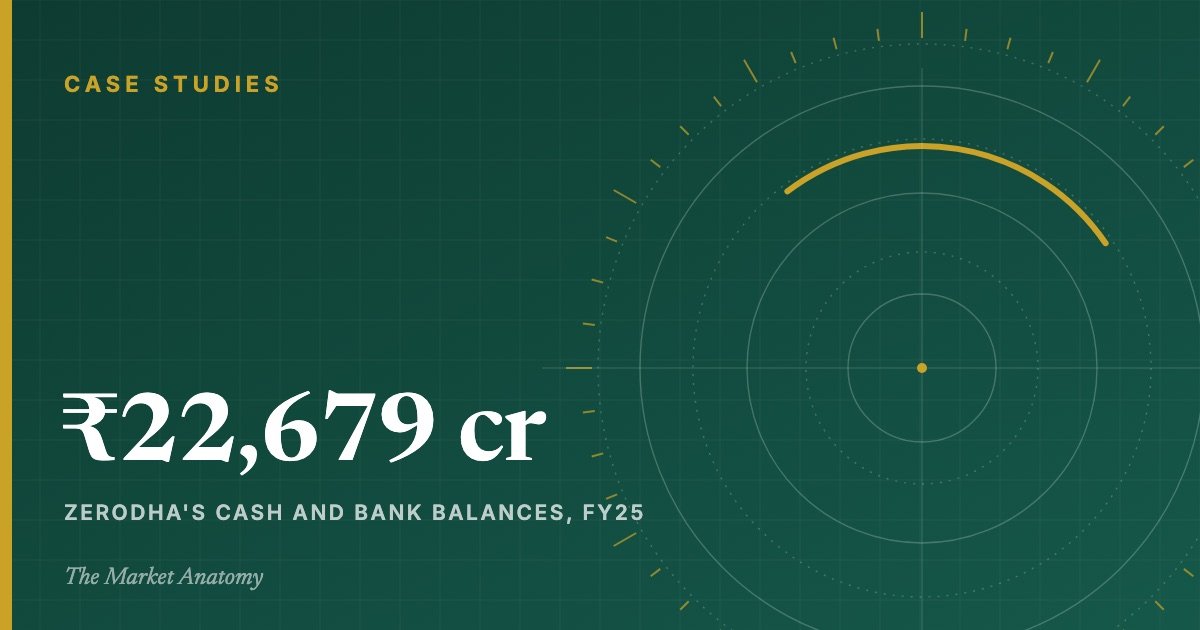
Two other numbers put the fall in context. First, the business remained very profitable, with reported operating margins above 60%. Second, Entrackr reported cash and bank balances of about ₹22,679 crore. Few Indian companies of any age hold that much cash, and Zerodha built it without selling a share to an outside investor.
A YourStory report in August 2026 said profit for FY26 was about ₹4,283 crore, roughly flat on the year, with revenue also broadly flat. The fall stopped, but the earlier growth did not return.
Where the model was exposed
The lesson here is not that Zerodha made a mistake. Its pricing was fair, its product was good and its customers chose to trade. The exposure was structural. When a large share of a company's revenue comes from one type of activity, and that activity sits under one regulator's authority, a single circular can reset the business.
Zerodha's leaders have been open about this risk in public posts and company updates, and the firm has spent years building other lines: mutual funds through its asset management arm, lending through Zerodha Capital, and early-stage investments through Rainmatter. Most of these are still small next to broking, but they point to a deliberate attempt to rely less on trading volume.
What founders can take from it
There are three lessons for any company, funded or not.
First, bootstrapping is a choice about who you answer to, not a shield against risk. Zerodha's independence let it avoid wasteful spending, but it could not protect the company from a change in the market's rules.
Second, profit concentration deserves the same attention as revenue concentration. A business can have millions of customers and still depend on a narrow behaviour among a minority of them.
Third, cash is strategy. The reserves Zerodha built in the good years mean it can absorb a weaker period, invest in new products and wait. Founders who spend every rupee of a boom have no such option when the boom ends.
The verdict
Zerodha remains one of the most remarkable companies in Indian business: bootstrapped, profitable at scale and trusted by a large base of investors. The FY25 accounts do not change that. They show that even the best-run firm is shaped by the market it operates in, and that the time to diversify is while the core business is still paying for it.
Sources and filings
Every figure in this story comes from the documents below. If you spot an error, write to corrections@themarketanatomy.com.
- Zerodha: About us
- Zerodha: Business updates, 13 years of Zerodha
- Zerodha: Brokerage charges
- Entrackr: Zerodha cash reserve stands at Rs 22,679 crore in FY25
- Indian Startup News: Zerodha net profit falls 23% to Rs 4,237 crore in FY25
- Business Standard: SEBI rolls out six measures to rein in F&O speculation
- YourStory: Zerodha marks 16 years with steady profits
This article is for information and education. It is not investment, legal or financial advice, and The Market Anatomy has no financial relationship with the companies named. See our editorial policy and disclaimer.