Costco sells groceries at cost and earns its profit at the door
Membership fees are under 2% of Costco's revenue but more than half of its operating income. A close reading of the 2024 annual report shows why the warehouse club can afford to keep prices low, and what would have to go wrong for the model to crack.
Key takeaways
- In fiscal 2024 Costco earned $4.83 billion from membership fees against $9.29 billion of operating income, so fees covered more than half of its operating profit.
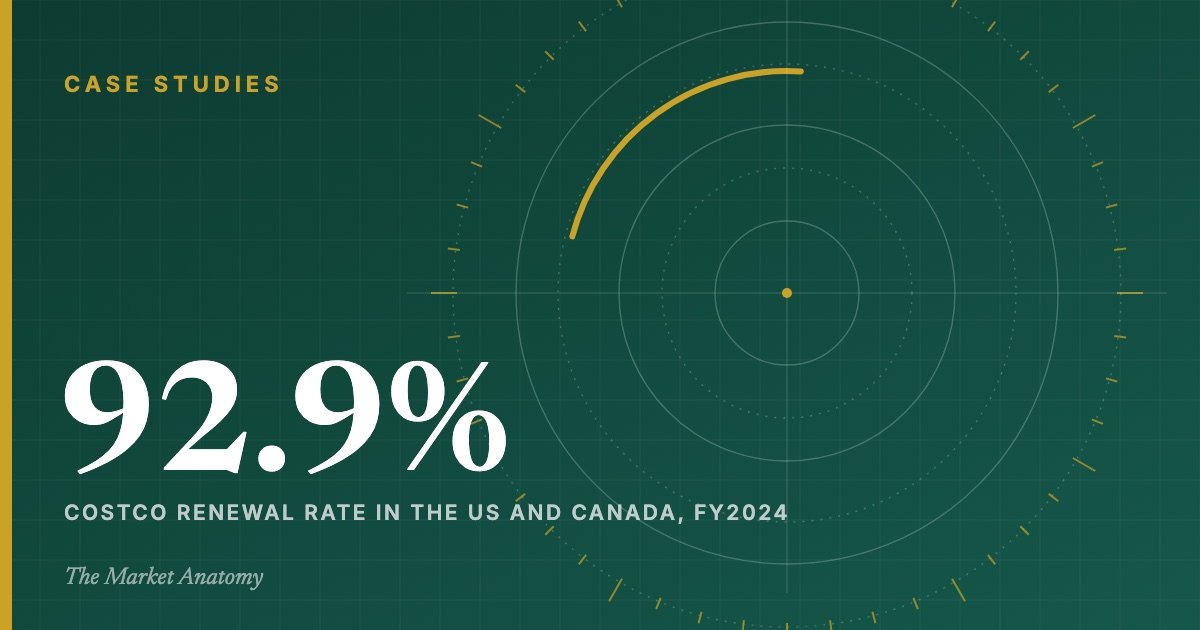
- Renewal rates of 92.9% in the US and Canada make that income unusually predictable, which lets the company price goods close to cost.
- Fee increases come rarely, roughly every five to six years, and the September 2024 rise was expected to add about $370 million over two years.
- The lesson for founders: charge for access, then use the access fee to fund prices that rivals relying on product margin cannot match.
Most retailers make money on the things they sell. Costco makes a large part of its money before a shopper picks up a trolley. To see how much, you only need two lines from the company's results for the fiscal year that ended on 1 September 2024.
Membership fees brought in $4,828 million. Operating income for the whole company was $9,285 million. Put those numbers side by side and the shape of the business becomes clear: the annual card in a member's wallet paid for more than half of Costco's operating profit, while the $249.6 billion of goods that passed through its warehouses paid for the rest.
That ratio explains almost everything else about the company, from the narrow aisles to the limited choice of brands to the rotisserie chicken that has sat at the same price for years.
How the model works
A Costco warehouse carries a few thousand products, far fewer than a typical supermarket or hypermarket. Each item sells in large volumes, often in bulk packs, which gives Costco buying power with suppliers. The company then passes much of that saving to the customer. Its gross margin on merchandise is thin by retail standards, because the goods are priced to win loyalty, not to fund the business on their own.
The fee does the funding. A Gold Star or Business membership in the US and Canada costs $65 a year after the September 2024 increase. An Executive membership costs $130 and returns 2% of eligible purchases as an annual reward, now capped at $1,250. Every member who renews hands Costco a high-margin payment with almost no direct cost attached to it.
Because that income is so profitable, Costco can run its stores close to break-even on the merchandise and still report healthy earnings. A rival that depends on product margin cannot follow it down on price without hurting its own profit.
Why the renewal rate matters more than the fee
A fee is only valuable if people keep paying it. Costco's 10-K for fiscal 2024 reported a renewal rate of 92.9% in the US and Canada and 90.5% worldwide. Put simply, more than nine in ten members in its core markets chose to pay again.
That number turns the fee from a one-off charge into something close to a recurring subscription. A business with a renewal rate above 90% can forecast a large share of next year's profit before the year begins. It can also plan new warehouses with some confidence that members will follow.
The renewal rate also acts as a check on management. If Costco ever raised prices on goods to squeeze out more margin, members would notice, and the place where they would show it is the renewal line. The company has every reason to keep the shopping trip feeling like a bargain, because the bargain is what sells the card.
The rare, careful price rise
Costco does not raise its fee often. Before September 2024 the last increase in the US and Canada was in 2017. The 2024 change lifted the basic fee from $60 to $65 and the Executive fee from $120 to $130, while raising the Executive reward cap from $1,000 to $1,250. In its annual report the company said it expected the change to add roughly $370 million in revenue over the following two years, with about $190 million of that falling in fiscal 2025.
The timing tells you something. Costco tends to raise the fee only after a long stretch of high renewals and only by a modest amount. It also sweetened the Executive tier at the same moment, which gave its most valuable members a reason to accept the higher price. Press coverage of the following year's annual report suggested renewals held up, with US renewal rates reported at about 92%.
For a subscription business this is the delicate part. Raise the fee too often and you invite members to count what they save. Raise it too rarely and you leave money on the table. Costco's answer has been to wait until the value is obvious and the increase looks small next to it.
What the numbers do not show
The model has costs that sit outside the fee line. Costco's stores need large sites, often on the edge of cities, and members need cars and storage space at home to make bulk buying worthwhile. That limits where the format works and who it serves.
The narrow range is also a choice with trade-offs. Shoppers who want a specific brand may not find it, and Costco relies on its own Kirkland Signature label to fill gaps. If that label ever lost the trust it has built, the company would lose one of its main tools for keeping prices low.
Finally, the model rewards scale. A new entrant cannot copy it on a small budget, because a warehouse club with few members has little buying power and a thin fee base. That is a strength for Costco, but it also means the playbook does not travel easily to a start-up.
What founders can take from it
The useful idea is the separation of two kinds of income. Costco charges for access and earns little on the transaction. Many software and service businesses work the same way without saying so: an annual plan funds the company, and individual features or orders are priced to keep customers happy.
Three questions follow for anyone building a business:
- Is there a part of your offer that customers would pay for up front, before they buy anything specific?
- If you earned your profit there, how much lower could you price everything else?
- What would you need to measure, every quarter, to know that customers still think the access is worth it?
Costco's answer to the third question is the renewal rate. It publishes it every year, and it treats a fall of even a fraction of a point as news. A founder who adopts the model should pick an equivalent number and watch it just as closely.
The verdict
Costco's success is often explained by its low prices. The annual report suggests the cause and effect run the other way. The membership fee, renewed by more than nine in ten members, gives the company a reliable profit stream, and that stream is what pays for the low prices. As long as the card feels like a bargain, the warehouse can keep selling at close to cost.
Sources and filings
Every figure in this story comes from the documents below. If you spot an error, write to corrections@themarketanatomy.com.
This article is for information and education. It is not investment, legal or financial advice, and The Market Anatomy has no financial relationship with the companies named. See our editorial policy and disclaimer.