How Netflix turned password sharing from a leak into a sales channel
For years Netflix tolerated shared logins. In May 2023 it rolled out paid sharing in more than 100 countries and then posted its best fourth quarter for subscriber growth. A teardown of what changed, why it worked and what it cost.
Key takeaways
- Netflix launched paid sharing in May 2023 in more than 100 countries that made up over 80% of its revenue base.
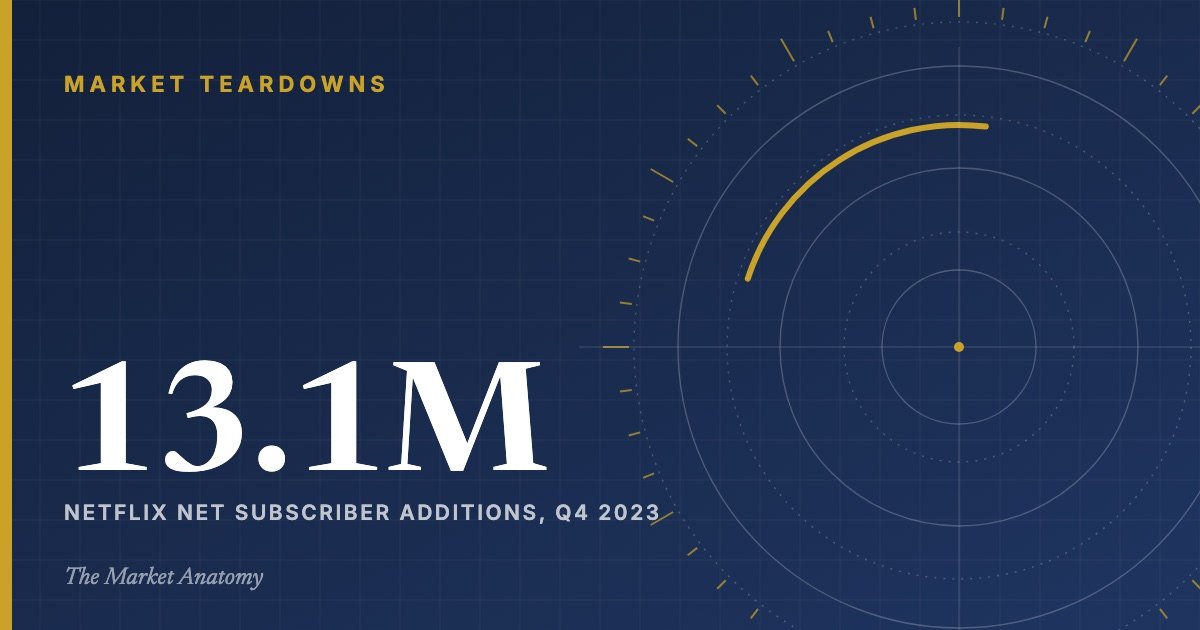
- Net additions rose through the year, from nearly 6 million in the second quarter to 8.76 million in the third and 13.12 million in the fourth, taking paid memberships to about 260 million.
- The move worked because it was paired with a cheaper ad-supported plan, which gave people a low-cost way to stay legitimate.
- The broader lesson: a free rider is a prospect you have already acquired. The trick is giving them a price they will accept.
For most of its life as a streaming service, Netflix made a quiet bargain with its customers. It knew that many accounts were shared beyond a single household, and it chose not to fight it. In 2017 the company's official account even joked about it on social media. Shared logins spread the habit of watching Netflix, and at the time the company cared more about reach than about who was paying.
By 2022 that bargain had stopped working. Subscriber growth had stalled, the share price had fallen sharply, and the company estimated in its shareholder letters that more than 100 million households were watching through someone else's account. What happened next is a useful case of a company converting a problem it had tolerated into a source of growth.
The mechanics of the change
Netflix tested different approaches in Latin America during 2022 before choosing a model it called paid sharing. The rules were simple. An account belongs to one household. If a member wants someone outside the household to keep using it, they can add an extra member for a monthly fee, which was set at $7.99 in the United States. Otherwise, the person borrowing the account needs a plan of their own.
In its shareholder letter for the second quarter of 2023, Netflix said that in May it had launched paid sharing in more than 100 countries, representing over 80% of its revenue base. In other words, it rolled out the change almost everywhere that mattered at once, rather than market by market.
What the numbers did
The fear inside and outside the company was a wave of cancellations. That wave never showed up in the reported numbers. Netflix added nearly 6 million net subscribers in the second quarter of 2023, then 8.76 million in the third quarter, taking it to about 247 million paid memberships. In the fourth quarter it added 13.12 million, its best fourth quarter on record, ending the year with about 260 million.
Netflix said some members cancelled, as expected, but that borrowers signing up for their own accounts and extra-member payments more than made up for them. Revenue grew too, because the new sign-ups paid full prices rather than nothing.
Why it worked: the second product
A crackdown on its own would have been risky. What made it work was the product Netflix had launched a few months earlier. In November 2022 it introduced a cheaper plan with advertising in a dozen markets. That plan gave a borrower who had been watching for free a low-cost way to keep watching legally.
This is the part of the teardown that matters most. Netflix did not simply close the door. It closed one door and opened a cheaper one next to it. A borrower faced a choice between losing access and paying a modest amount, and many chose to pay. The ad tier also brought in advertising revenue on top of the subscription, which raised the value of a low-price customer.
Two other conditions helped. Netflix's catalogue was large and its hit shows kept people engaged, so the cost of leaving felt high. And the company had years of usage data that let it estimate how many borrowers there were and where they lived, which shaped the price of the extra-member option.
What it cost
The change was not free. It required engineering to detect households, customer service to handle confused members, and a period of public criticism. Some long-time members resented the change and said so. Netflix also accepted a short-term cancellation spike in each market as the rules took effect.
There is a longer-term trade-off as well. A shared login was a cheap way for new viewers to discover the service. With that door closed, Netflix now depends more on its own marketing and on the ad tier to bring in first-time users. In 2024 the company said it would stop reporting quarterly subscriber numbers from 2025, shifting attention to revenue and engagement, which suggests it sees future growth coming from price and advertising rather than from raw sign-ups.
How to use the idea
The pattern applies well beyond streaming. Many software products, publications and services have users who get value without paying: shared seats on business software, forwarded newsletters, borrowed logins. Netflix's experience suggests a three-step approach:
- Measure the free riders before acting. Netflix's household estimate gave it a target and a way to judge results.
- Offer a cheaper legitimate option before or alongside the crackdown, so that people have somewhere to go.
- Roll out with confidence once tests show the conversion rate. A slow, country-by-country change would have given critics more time and competitors more room.
The verdict
Netflix's paid sharing is often described as a crackdown. Looked at closely, it was closer to a sales campaign aimed at people who already loved the product. The company had acquired those viewers for free years earlier. In 2023 it gave them a price they were willing to pay, and turned a leak into its strongest year of subscriber growth in a long time.
Sources and filings
Every figure in this story comes from the documents below. If you spot an error, write to corrections@themarketanatomy.com.
This article is for information and education. It is not investment, legal or financial advice, and The Market Anatomy has no financial relationship with the companies named. See our editorial policy and disclaimer.