ASML, the Dutch company every advanced chip depends on
ASML is the only company that makes extreme ultraviolet lithography machines, the tools needed to print the most advanced chips. Its 2025 results show what a near-monopoly built over decades looks like on paper, and why it also makes the company a political asset.
Key takeaways
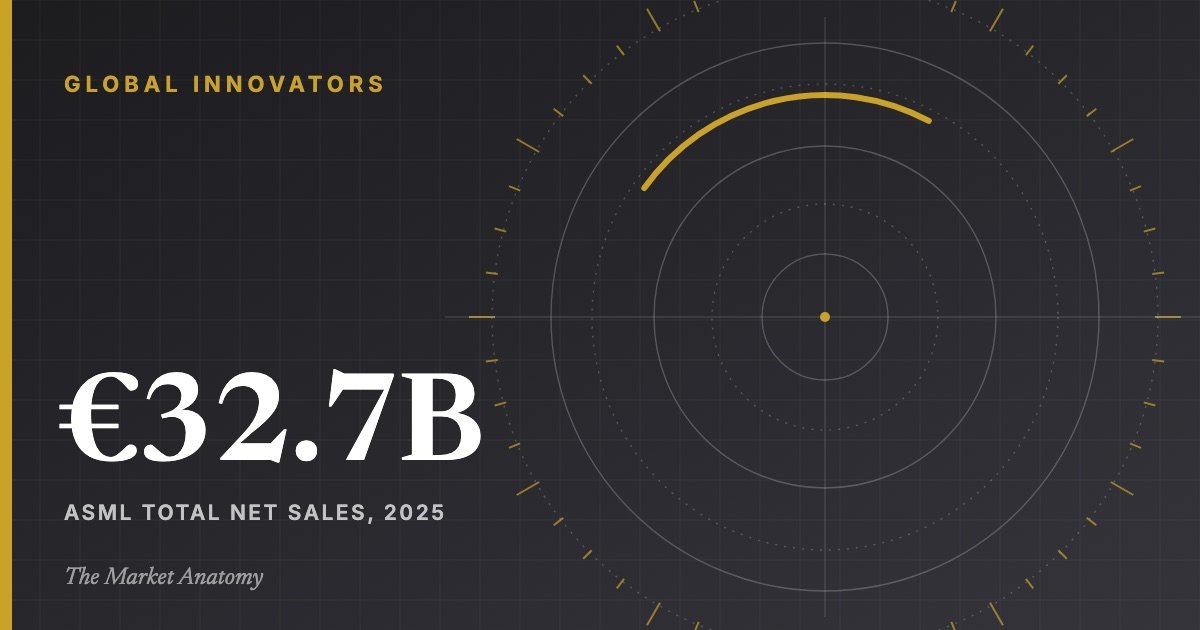
- ASML reported record 2025 net sales of €32.7 billion and net income of €9.6 billion, with EUV system sales of €11.6 billion from 48 machines.
- EUV machines print chip features using light with a wavelength of 13.5 nanometres. No other company sells them.
- The advantage rests on decades of R&D and a supply chain of specialist partners, which makes it very hard for a rival to catch up.
- That position also makes ASML a tool of export policy, and its sales to China are limited by Dutch and US rules.
In Veldhoven, a small town in the south of the Netherlands, ASML assembles machines the size of a bus that print patterns onto silicon wafers. The company is not a household name. Yet almost every advanced processor made today, in phones, data centres and AI systems, passes through one of its machines at some stage of production.
ASML's results for 2025 show how valuable that position has become. Net sales reached a record €32.7 billion, up about 16% on 2024. Net income was €9.6 billion and the gross margin was 52.8%. At the end of the year the company had a backlog of €38.8 billion of orders.
What the machines do
A chip is built in layers. For each layer, a lithography machine shines light through a mask, a kind of stencil, and projects the pattern onto a wafer coated with light-sensitive material. The smaller the wavelength of the light, the finer the patterns it can print, and the more transistors fit on a chip.
For decades the industry used deep ultraviolet light. To go further, it needed extreme ultraviolet, or EUV, light with a wavelength of 13.5 nanometres. EUV is absorbed by almost everything, including air and ordinary lenses, so the machines must work in a vacuum and use precisely shaped mirrors. ASML describes the light source as one that fires a laser at tiny droplets of molten tin, turning them into plasma that gives off EUV light, tens of thousands of times a second.
ASML is the only company that sells EUV machines. Chipmakers that want to produce the most advanced chips have no other supplier.
How the monopoly was built
The position did not come quickly. EUV research began in the 1990s, and the first machines suitable for volume production arrived only in the late 2010s. Along the way ASML spent heavily on research, brought in customers such as Intel, Samsung and TSMC as co-investors in its development programmes, and bought the US light-source maker Cymer in 2013 to control a critical component.
It also depends on a network of specialist suppliers. The mirrors and optics come from Carl Zeiss in Germany, which has worked with ASML for decades. Thousands of other parts come from suppliers that have built their businesses around ASML's needs. A rival would have to rebuild that whole network, not just design a machine.
The result is a business where the scarce thing is time. Even a well-funded competitor would need many years to reach where ASML is now, and by then ASML would have moved on.
The numbers behind the machines
In 2025 ASML recognised revenue on 48 EUV systems, including its newest High-NA models, for total EUV system sales of €11.6 billion, up 39% on the year before. It shipped 300 new lithography systems in total, fewer units than in 2024, but the mix moved towards the more expensive EUV tools.
ASML does not publish list prices. Press reports, including one from the German technology publication heise, put a standard EUV system at roughly €170 million to €200 million and a High-NA system at around €350 million. These are estimates rather than official figures, but they explain why a relatively small number of machines can produce such large revenue.
Fourth-quarter bookings were €13.2 billion, of which €7.4 billion were EUV, as chipmakers expanded capacity for AI processors.
The political side of a monopoly
A company that controls a chokepoint becomes a matter of state policy. The Netherlands has not licensed the export of EUV machines to China, and Dutch and US rules have since been extended to some advanced deep ultraviolet tools as well. Reporting on ASML's long-range outlook notes that its sales to China have lagged as a result, while demand elsewhere has risen.
For ASML this is a real constraint. China was a large buyer of its older machines, and export rules can change with little notice. The company has to plan its production years ahead while governments decide where its products may go.
What founders and operators can take from it
ASML is an unusual company, and few businesses will ever hold a position like it. But two ideas travel.
First, deep technical moats are built by sticking with a hard problem for longer than others are willing to. ASML's lead comes from decades of work on a technology that many in the industry once doubted.
Second, a moat can be built from relationships as much as patents. ASML's partnerships with suppliers and customers, who helped fund its research, made its success their success. That shared investment is part of why no one has tried seriously to build a rival.
The verdict
ASML shows what a near-monopoly looks like when it is earned through engineering rather than regulation or network effects. Its 2025 results are a record, and its order book points to more growth. The same position that makes it so valuable also puts it in the middle of geopolitics, which is the one risk its engineers cannot solve.
Sources and filings
Every figure in this story comes from the documents below. If you spot an error, write to corrections@themarketanatomy.com.
This article is for information and education. It is not investment, legal or financial advice, and The Market Anatomy has no financial relationship with the companies named. See our editorial policy and disclaimer.